Anxiety vs Fear: What’s the Difference?
Anxiety is a natural alarm system, but it can get too loud. Fear helps us survive real danger in the moment, while anxiety often shows up when our brain predicts a threat that may never happen. When anxiety stays switched on, it can affect sleep, mood, focus, relationships, and the choices that shape your life. In this guide, we explain how fear and anxiety work, how to spot the signs, and what you can do today to calm your body, steady your thoughts, and get back to the life you want. Anxiety is the anticipation of a possible threat, while fear is the response to an immediate danger you can point to right now.Fear in the Present
Fear is a powerful human emotion triggered by a real or perceived threat. It sparks the fight-or-flight response that has protected humans for thousands of years.
Anxiety About the Future
Anxiety is more about anticipation. It is the uneasy sense that something bad might happen, even if the threat is unclear or far away. Anxiety prepares us for the possibility of danger, but when it becomes constant, it can hold us back.
Simple way to remember: Fear is a reaction to the present. Anxiety is worry about the future.
Throughout evolution, fear has been a pivotal and vital response to danger. In ancient times when men and women regularly faced life-or-death situations, fear allowed our species to survive from legitimate threats.
Today, the stakes are lower, and although we are not faced with the same type of dire consequences that faced early man, at least “60 percent of adults admit to having at least one unreasonable fear”. Although research to date is not clear on why these fears manifest, one theory is that humans have a genetic predisposition to fear things that were a threat to our ancestors, such as snakes, spiders, heights, or water. Others point to evidence that individuals fear certain things because of a previous traumatic experience, but that fails to explain the many fears that effect people even when this isn’t the case.There are 3 sources of fear:
1.External
Mortal danger fear where your life is under threat.
2.Internal
Situational ‘contained’ fear where your fear is linked to a specific object, activity or situation.
3.Subconscious
A pervasive ‘bleeding’ fear where there is a general state of fear that is present across your life.
How does fear work?
When we confront a perceived threat, our bodies respond in specific ways. This response known as the ‘fight or flight’ response, is where our body prepares itself to either enter combat or run away.
As soon as you recognize fear, your amygdala (small organ in the middle of your brain) goes to work. It alerts your nervous system, which sets your body’s fear response into motion. Stress hormones like cortisol and adrenaline are released. Your blood pressure and heart rate increase. You start breathing faster. Even your blood flow changes — blood actually flows away from your heart and into your limbs, making it easier for you to start throwing punches, or run for your life. As some parts of your brain are revving up, others are shutting down. When the amygdala senses fear, the cerebral cortex (area of the brain that harnesses reasoning and judgment) becomes impaired — so now it’s difficult to make good decisions or think clearly. As a result, you might scream and throw your hands up when approached by an actor in a haunted house, unable to rationalize that the threat is not real.Physical responses to fear:
- High adrenaline levels
- Increased heart rate
- Chest pains, temporary paralysis or an erratic heartbeat
- Stomach pain, head pain, or nausea
- Dizziness or fainting
- Sweating and or chills
- Dry mouth
- Muscle tension, twitching, or trembling
- Crying
- Stuttering
- Erratic sleep patterns
- Loss of appetite
- Rapid or shallow breathing
The brain reacts to 3 types of events:
1.Inherited
Historically harmful events like falling.
2.Acquired
Learned events like losing a loved one.
3.The Unknown
The inability to understand an event like death.
How fear impacts our thinking
Once the fear pathways are ramped up, the brain reacts in predictable ways by helping us focus on the presenting danger and then storing it in our memory in the following way:
- The brain short-circuits more rational processing paths and reacts immediately to signals from the amygdala;
- When in this overactive state — sometimes called ‘the amygdala hijack’’’ —the brain perceives events as negative and remembers them that way;
- The brain stores all the details surrounding the danger — the sights, sounds, odors, time of day, weather, and so on — and these memories tend to be very durable, although they may also be fragmented;
- The details of the event can trigger fear later — the sights, sounds, and other contextual details of a fearful event may bring back the memory, or they may cause us to feel afraid without consciously knowing why — because these cues were associated with the previous danger, the brain may see them as a predictor of threat;
- In severe cases, reacting to cues associated with a previous danger as a predictor of threat, can result in post-traumatic stress disorder (PTSD).
What can trigger fear:
All people experience some type of fear. Humans and animals typically possess innate fearful reactions to certain stimuli, such as unexpected or loud noises. These ‘triggers’ differ from one person to the next and can include:- Public speaking
- Flying in an airplane
- Being alone
- The unknown
- Failure
- Being rejected
- Confrontation
- Aggression, violence, or war
- Stray or wild animals
Fear and mental health
In addition to the physical symptoms, people may experience psychological symptoms of being overwhelmed, upset, feeling out of control, or a sense of impending death.
Fear has been linked with numerous behavioral and mental health concerns. In many ways, you could say that fear is at the centre of most conditions. For example, anxiety issues involve fear of a future event or occurrence. The psychological effects of fear can include intrusive or distracting thoughts, loss of focus, and confusion. People may also experience a variety of emotional states, including terror, anxiety, or panic. The intensity of these emotional states varies. We can feel mild or strong anxiety, but we can only feel intense terror. But, all states of fear are triggered by feeling a threat of harm.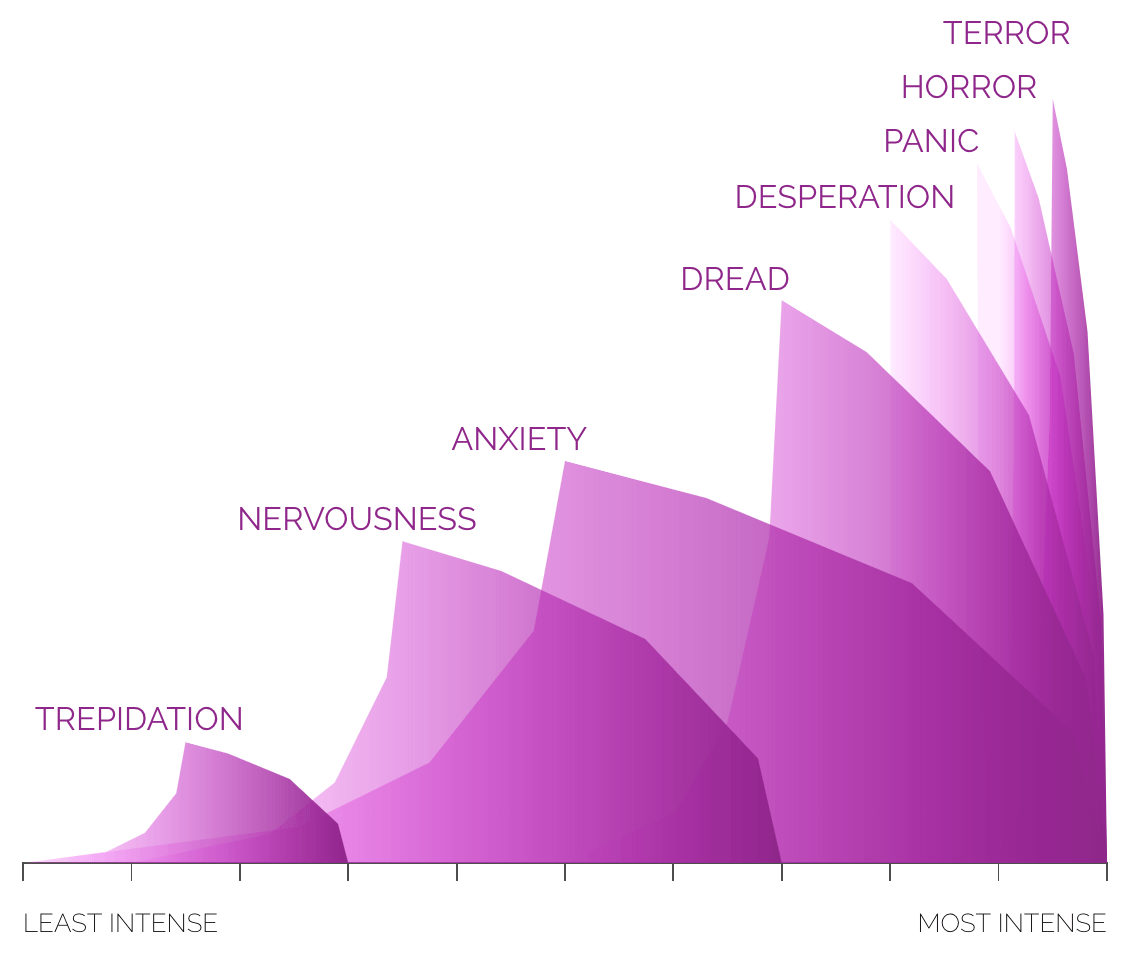
IMAGE SOURCE: ATLAS OF EMOTIONS The States of Fear
Types of fears:
- Fear of failure
- Fear of judgment
- Fear of success
- Fear of speaking
- Fear of not being able to make a living
- Fear of rejection
- Fear of humiliation
- Fear of losing everything
- Fear of people and public places
Fear can lead to:
Fear is listed as a contributing factor or symptom of conditions such as:- Generalized anxiety
- Social anxiety
- Separation anxiety
- Phobias
- Obsessions and compulsions
- Paranoia
- Panic Disorder
- Post Traumatic Stress Disorder (PTSD)
- Depression
- Schizophrenia
Some feelings commonly described as “fears” are mental obstacles that limit people’s actions and decisions, often preventing them from making progress, such as the fear of failure, the fear of success, the fear of rejection, the fear of missing out, or the fear of commitment.
These fears can involve your relationships, career, and day to day interactions — leaving you with feelings of insecurity, unworthiness, or indecision — and holding you back from the life you want in the following ways:Fear of change = getting stuck in a rut
Despite the fact that we live in an ever-changing world, many people who fear change, resist it. When you try hard to keep things ‘the way they are’, to stay ‘safe or comfortable’, you avoid taking risks. This avoidance could cause you to miss out on many good opportunities that come your way, and you run the risk of becoming stagnant and getting stuck in a rut.Fear of loneliness = unhealthy social interactions
While it’s smart to ward off loneliness, it’s important to surround yourself with healthy people and healthy social interactions, as the fear of loneliness can result in unhealthy relationships and behaviours. For example: staying in a bad relationship simply to ‘not be alone’, or obsessively using social media to extent that you miss out on making face-to-face connections.Fear of failure = perfectionism, procrastination or self-sabotage
One of the most common fears on earth is the fear of failure. While it may feel embarrassing to fail, failure is a necessary part of learning and growth. For many, the fear of failure can lead to perfectionism, procrastination or atychiphobia (an irrational and persistent fear of failing). This means that you are so afraid of failing that you actually sabotage your efforts. As an example, you may simply not start a big project, ultimately failing as a result. The idea here is that it’s better to fail by not starting than to fail after putting in a lot of effort. All this does, is reinforce your beliefs that you don’t measure up and you end up avoiding doing anything where success isn’t guaranteed. Ultimately you'll miss out on all the life lessons and opportunities that might help you find success.Fear of rejection = missed opportunities
Everyone wants to feel wanted and accepted but many people avoid social interactions like meeting new people or trying to enter into a new relationship because they fear of rejection. And, this fear of rejection is not limited to personal connections, as it can include asking your boss for a raise or putting your talent on stage. While rejection stings, the fear of rejection can keep you stuck and missing out on opportunities that you want… like being in a committed relationship, getting that raise or being recognized for your unique abilities.Fear of the unknown = prevents you from moving forward
It’s not unusual to feel hesitant when trying something for the first time. People often avoid trying something different for fear of uncertainty. After all, there's no guarantee that doing something new or different will make life better. But staying the same and not trying anything new is one surefire way to stay stagnant. Whether you're afraid to accept a new job or afraid to move to a new city, when you let the fear of uncertainty hold you back, it prevents you from moving forward.Fear of something bad happening = prevents you from enjoying life
It is an inevitable fact of life that bad things will happen and it’s important to know that you can’t prevent all bad things from happening (either to you or someone else). This is especially the case, when a loved one or innocent life is taken without notice or cause. But if you let the fear of doom pervade your life, it prevents you from enjoying a rich full life that’s also full of good things too.Fear of getting hurt = prevents meaningful connections
Sometimes our fears of getting hurt — like looking both ways before we cross the street — are valuable because they protect us from getting hurt. But when fears of getting hurt cause you to become emotionally overprotective of yourself, your fear of uncomfortable feelings and emotional wounds might prevent you from making deep, meaningful connections. It’s important to remember that without emotional risk, there aren't any rewards.Fear of being judged = not being your true self
It's normal to want to be liked. It’s normal to want to be accepted. But the fear of being judged can prevent you from being your true self. When you ‘pretend’ to be someone else or play an ‘assigned role’ that makes other people feel comfortable, you are denying your own potential, self-worth and truth. And, the truth is, some people will judge you harshly no matter what. Trusting yourself and being mentally strong enough to live according to your values is key to living your best life.Fear of inadequacy = not feeling worthy of success
Another fear shared by many people is the feeling of not being good enough. If you feel like you don't measure up, you might become an underachiever. Or, you might become a perfectionist in an effort to try and prove your worth. While it's hard to face it head-on, no one’s opinion is as important as your own. Even if you achieve success (based on other peoples’ terms), you'll never really succeed until you feel worthy of your success.Fear of losing of freedom = can hold you back
A certain amount of this fear can be healthy, but it becomes a problem when it holds you back in life. For example, someone who wants to live a “free life” might avoid getting a job with a steady income. Consequently, they might miss out on the freedom that comes with financial stability. In this case, the fear of the loss of freedom becomes a self-fulfilling prophecy.What’s the difference between fear and anxiety?
Although both are alerting signals, they appear to prepare the body for different actions.Anxiety
- A generalized response to an unknown threat or internal conflict
- Refers to the anticipation of a future concern
- More associated with muscle tension and avoidance behaviour
Fear
- An emotional response to an immediate threat
- More associated with our fight or flight survival instinct and reacting to a specific event or object
What’s the difference between fears and phobias?
Fears
- Are normal, common reactions to events or objects like running when you see a wild animal or being anxious before speaking in front of a crowd
Phobias
- A fear becomes a phobia when it interferes with your ability to function and maintain a consistent quality of life
- You start taking extreme measures to avoid an event or object (like water, spiders or people), you may have a phobia
The impact of chronic fear
Living under constant threat has serious health consequences.Physical health
Fear weakens our immune system and can cause cardiovascular damage, gastrointestinal problems such as ulcers and irritable bowel syndrome, and decreased fertility. It can lead to accelerated ageing and even premature death.
Memory
Fear can impair formation of long-term memories and cause damage to certain parts of the brain, such as the hippocampus. This can make it even more difficult to regulate fear and can leave a person anxious most of the time. To someone in chronic fear, the world looks scary and their memories confirm that.
Brain processing and reactivity
Fear can interrupt processes in our brains that allow us to regulate emotions, read non-verbal cues and other information presented to us, reflect before acting, and act ethically. This impacts our thinking and decision-making in negative ways, leaving us susceptible to intense emotions and impulsive reactions. All of these effects can leave us unable to act appropriately.
Mental health
But if you find yourself terrorized, traumatized and unable to function, you might be experiencing more than just fear. Other consequences of long-term fear include fatigue, clinical depression, and PSTD.
Overcoming fear (and anxiety)
Acknowledging your fears and facing them head-on could be key to reaching your greatest potential.
The events of the last few years — including a worldwide pandemic and images of racist and terrorist attacks, demonstrations and protests — have altered and in many ways increased our fears and made them more pronounced. Across the globe, we collectively shared a fear of loved ones (and ourselves) becoming sick or dying. Reports of ‘the dead’ and civil unrest within the media created ‘doom-scrolling’ and increased our shared anxiety in the uncertainty of what was going to happen week to week. We were isolated from friends and family, took on remote work, schooling and numerous lock-downs, missed major milestones and events, and even dealt with a toilet paper shortage. All of these events combined together amplified our greatest fear… our mortality.So how do we move forward from all this fear and anxiety?
No one lives without fear, but if you know how to respond to and manage your fears, you can move forward. First, do not be afraid of being afraid. Know it’s a feeling that is sometimes unavoidable, and that it’s a feeling that can be useful when it’s recognized as an alert and not a barrier. With this knowledge, you can prepare without panicking, take action instead of shying away, and ask for help when your fears take over. There are also steps that you can take to help cope with fear in your day to day life. These strategies focus on helping you manage the physical, emotional, and behavioural effects of fear.Practice mindfulness and use stress management techniques to relax
While you cannot always prevent certain emotions, being mindful can help you manage them and replace negative thoughts with more helpful ones. Using stress management techniques and learning relaxation techniques such as deep breathing, muscle relaxation and visualization can help you with the mental and physical feelings of fear. It can help just to drop your shoulders and breathe deeply, or to imagine yourself in a relaxing place. You could also try learning things like yoga or meditation.Take care of your health
Eat well, get regular exercise, get adequate sleep each night, avoid alcohol, or drink in moderation. It’s very common when we are stressed, to lose sight of those healthy habits that we know make us feel better. Eat lots of fruit and vegetables, and try to avoid too much sugar. Resulting dips in your blood sugar can give you anxious feelings. Try to avoid drinking too much tea and coffee, as caffeine can increase anxiety levels. Increase the amount of exercise you do as not only is it good for you physically, it can take your mind off your fear and anxiety. And, although it is very common for people to drink when they feel nervous — liquid courage for some — the after-effects of alcohol can make you feel even more afraid.Know yourself
Minding our thoughts, acknowledging our fears, and being present can go a long way toward managing our everyday fears. The first step is to question the “why” or the ‘story’ behind a fear. The ability to step back and recognize your thoughts as ‘stories’, and calmly evaluate whether they are true or rational can be a powerful step toward overcoming the fear. Try to learn more about your fear or anxiety by keeping a record or when it happens and what happens. Make a note of the following:- What does your fear relate to?
- When do you experience fear the most, and about what things specifically?
- What are the common triggers which cause that fear to stir within you?
Face your anxiety and fear
All types of fear are helpful in some way, because fear is an invitation to shift… to shift externally like moving your body out of danger, or shifting internally like changing what you believe and think. Fear is pointing out a limitation within your perception and interpretation of “reality”. It is highlighting negative beliefs and thought patterns that you need to evolve beyond. In these ways, fear is supporting you as it is either fuel for your safety or fuel for your personal growth — it is healthy and natural and in itself — and is not actually a problem. The problem is when your mind takes over and buys into and feeds the fear, generating more thoughts that support and magnify it. In this case, your mind gains momentum and the fear starts to own you, escalating to the point where you are paralyzed. So while fear is a healthy and natural invitation to shift, what is not healthy is letting it escalate out of control and stop you from living. If you always avoid situations that scare you, you will eventually stop doing things you want and need to do. When fear disrupts or overtakes your life, therapy is a productive way to help you cope and deal with what is holding you back. Therapy is a means to realize that you are not your thoughts. Once you can observe your own thoughts and emotions objectively, you are no longer controlled by them, and can start boldly growing forward.Top Fears 2020 / 21
The Chapman University Survey of American Fears was taken in January of 2021, where a random sample of 1035 adults across the United States was asked about 95 different fears ranging from topics about the environment, government, natural disasters, COVID-19, and many more. Below is a list of the top 10 fears for which the highest percentage reported being “Afraid” or “Very Afraid.”- Corrupt government officials 79.6%
- People I love dying 58.5%
- A loved one contracting the coronavirus 58%
- People I love becoming serious ill 57.3%
- Widespread civil unrest 56.5%
- Another pandemic or a major epidemic 55.8%
- Economic / financial collapse 54.8%
- Cyber-terrorism 51%
- Pollution of oceans, rivers and lakes 50.8%
- Biological warfare 49.3%
Treatments for Fears and Phobias
Somatic therapy
Fear shows up in the body as much as in the mind. Somatic therapy helps you notice and gently shift the sensations that keep fear looping. We’ll map where you feel it, slow the breath, release bracing patterns, and build nervous system flexibility. Skills include grounding, paced breathing, orienting to the room, and small movements that let your body complete stress responses safely. Over time, your baseline settles and spikes get easier to ride.
EMDR
Eye Movement Desensitization and Reprocessing helps the brain process stuck fear memories so they lose their intense charge. We’ll start with preparation and resourcing, then identify the images, sensations, and beliefs that show up during fear. Using sets of bilateral stimulation, we check in after each set and continue until the memory feels less vivid and less disturbing. The goal is for your nervous system to update the story so present-day triggers don’t hit as hard.
CBT
Cognitive Behavioural Therapy teaches you to spot unhelpful thoughts, test them, and practise new responses. Together we’ll name the patterns that show up during fear, develop flexible thinking, and rehearse small behavioural steps that fit your life. You’ll get simple worksheets and between-session practices so progress doesn’t rely on willpower alone.
Common CBT skills we teach:
-
Thought spotting and flexible alternatives
-
Behavioural experiments you can do in a typical week
-
Attention training so worry doesn’t run the show
Medication
Your physician or mental health provider may recommend medication such as beta-blockers, which block adrenaline and lower heart rate and blood pressure. Prescribed for the short-term, it is often used when a feared situation is necessary or unavoidable, such as before a public speaking commitment.Technology
The use of virtual reality to simulate exposure to fears has emerged as a useful therapeutic tool. Evidence suggests that Virtual Reality Graded Exposure Therapy (VRGET) can be especially helpful in addressing concerns like specific phobias, agoraphobia, and anxiety disorders. Patient outcomes appear to be no different in virtual verses real settings, but this therapeutic treatment enables therapists to reach more people with accessible and affordable care.We’re here if you need help.
Therapy is a valuable tool that can help you to solve problems, set and achieve goals, or teach you new ways to track your emotions and keep your fears in check. It can help you to build the life, career, and relationship that you want. Does everybody need it? No. But if you are curious about working with a therapist, that curiosity is worth pursuing.We know it takes a great amount of courage to examine your life and to decide that there are things you would like to change. And it takes more courage to do something about it. Support from a trusted adult, a counsellor, or a therapist can make a real difference in how you feel day to day.
At The Dot, we can help. We offer free consultations for anyone in Ontario considering individual or couples counselling, online at The Dot. We will go through any of your questions and concerns to help you decide whether online counselling is the right choice for you.
Book Your Consultation Today!
Visit our therapist match form to let us match you to the therapist with the skills you need.
SOURCES AJMC The Effects of Chronic Fear on a Person’s Health Chapman University America’s Top Fears 2020/2021 Medical News Today Dissecting terror: How does fear work? Mental Health Commission of Canada The Pandemic and Your Mental Health - What’s the difference between fear and anxiety? Mental Health Foundation How to overcome fear and anxiety NAMI Anxiety Disorders National Institute of Mental Health Panic Disorder: When Fear Overwhelms Psychology Today Fear Psychology Today Fight or Flight: Which Is a Better Choice?